AR 670-1: 3-16. Religious accommodations
Quick Answer
Soldiers may request religious accommodations for dress and appearance standards. Requests are evaluated based on sincerity of belief, military necessity, and impact on unit cohesion. Approved accommodations may include beards, hijabs, turbans, and other religious items.
Important
Unit and command policies may be more restrictive than AR 670-1. Always verify with your chain of command for local policies.
Official Source
View AR 670-1, Section 3-16 (Pages 29-32)Full Details
3-16. Religious accommodations
Note. The following uniform and grooming standards apply only to Soldiers with a religious accommodation request approved in accordance with AR 600–20 for one or more of the listed practices.
a. Hijab (Head Scarf).
(1) An accommodated Soldier may wear a hijab (head scarf) made of a subdued material in a color that closely
resembles the assigned uniform (generally black, brown, green, tan, or navy blue as appropriate). The material will be free of designs or markings, except that a Soldier wearing the ACU may wear a hijab in a camouflage pattern matching the uniform. When directed by a commander, the Soldier may be required to wear a hijab made of fire-resistant ma- terial.
(2) The hijab will be worn in a neat and conservative manner that presents a professional and well-groomed ap-
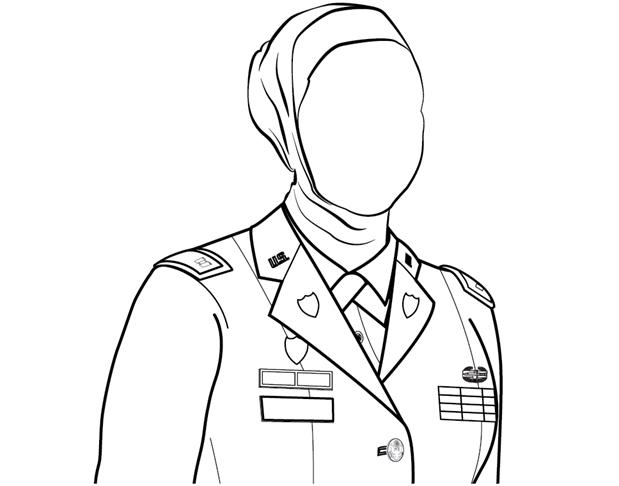
pearance. The hijab must be closely fitted to the contours of the head and neck and may not cover the eyebrows, eyes, cheeks, nose, mouth, or chin. The bottom edges of the hijab will be tucked under the Soldier's uniform top and all required headgear will still be worn.
(3) Hair underneath the hijab must be worn in a hairstyle authorized for the Soldier in paragraph 3–2. The bulk of
the Soldier's hair and hijab may not impair the ability to wear required headgear, the ACH, or other protective equip- ment; impede the ability to operate an assigned weapon, military equipment, or machinery; or interfere with the ability to perform the Soldier's military duties (see fig 3–5).
Figure 3–5. Hijab
b. Beard.
(1) Beards (which include facial and neck hair) must be maintained to a length not to exceed 2 inches when meas-
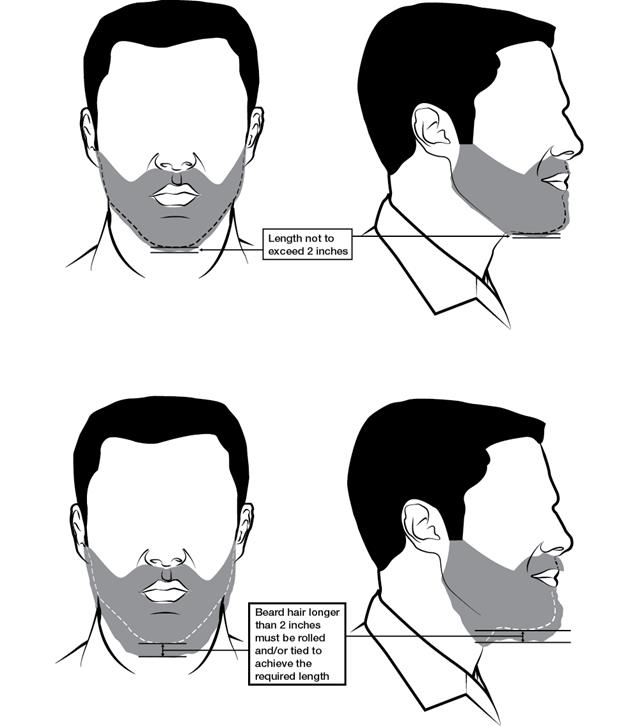
ured from the bottom of the chin. Beard hair longer than 2 inches must be rolled and/or tied to achieve the required length. Beards must be worn in a neat and conservative manner that presents a professional appearance. Soldiers may use styling products to groom or hold the beard in place, but may not use petroleum-based products if wearing a protective mask during training. The bulk of a Soldier's beard may not impair the ability to operate an assigned weapon, military equipment, or machinery.
(2) A mustache worn with a beard may extend sideways beyond the corners of the mouth to connect with the beard,
but must be trimmed or groomed to not cover the upper lip (see fig 3–6).
Figure 3–6. Beard figure
c. Turban and under-turban.
(1) An accommodated Soldier may wear a turban (or under-turban or patka, as appropriate) made of a subdued
material in a color that closely resembles the headgear for an assigned uniform. Commanders may designate conditions where the under-turban will be worn instead of the turban. The turban or under-turban will be worn in a neat and conservative manner that presents a professional and well-groomed appearance. The material will be free of designs or markings, except that a Soldier wearing the ACU may wear a turban or under-turban in a camouflage pattern
matching the uniform. Soldiers assigned to units wearing the maroon, tan, or green beret may wear an appropriately colored turban or under-turban as directed by the unit commander. When directed by a commander, the Soldier may be required to wear an under-turban made of fire-resistant material.
(2) Unless duties, position, or assignment require a Soldier to wear the ACH or other protective headgear, Soldiers
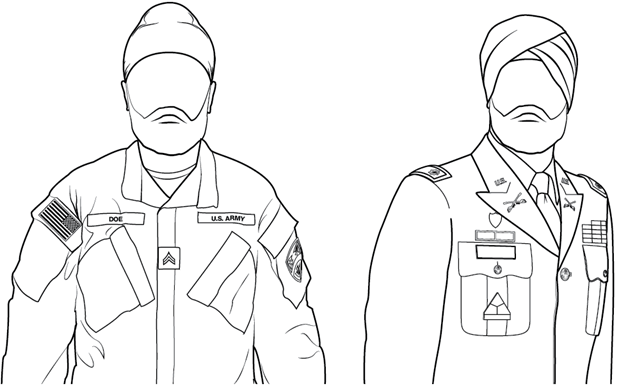
granted this accommodation are not required to wear military headgear in addition to the turban or under-turban. Rank will be displayed on the turban or under-turban when worn in circumstances where military headgear is customarily worn and removed in circumstances where military headgear is not customarily worn, such as indoors or in no-hat/no- salute designated areas.
(3) Hair worn under the turban or under-turban is not subject to AR 670–1 standards, but may not fall over the ears
or eyebrows or touch the collar while in uniform. When the Soldier is wearing an ACH or other protective headgear with the under-turban, the bulk of the hair will be repositioned or adjusted to ensure proper fit (see fig 3–7).
Figure 3–7. Turban figure
d. Physical fitness. An accommodated Soldier may wear commercial leggings under the physical fitness uniform
shorts. The leggings must be black in a subdued material. The material will be plain, with no logos, patterns, or obtrusive markings. An accommodated Soldier may wear the long sleeved physical fitness shirt.
Related Figures
Related Topics
Get AR 670-1 Update Alerts
Be the first to know when Army Directives change uniform policies.
Disclaimer: This information is provided for educational purposes only. AR670.com is not an official U.S. Army resource. Always verify guidance with official publications and your chain of command.